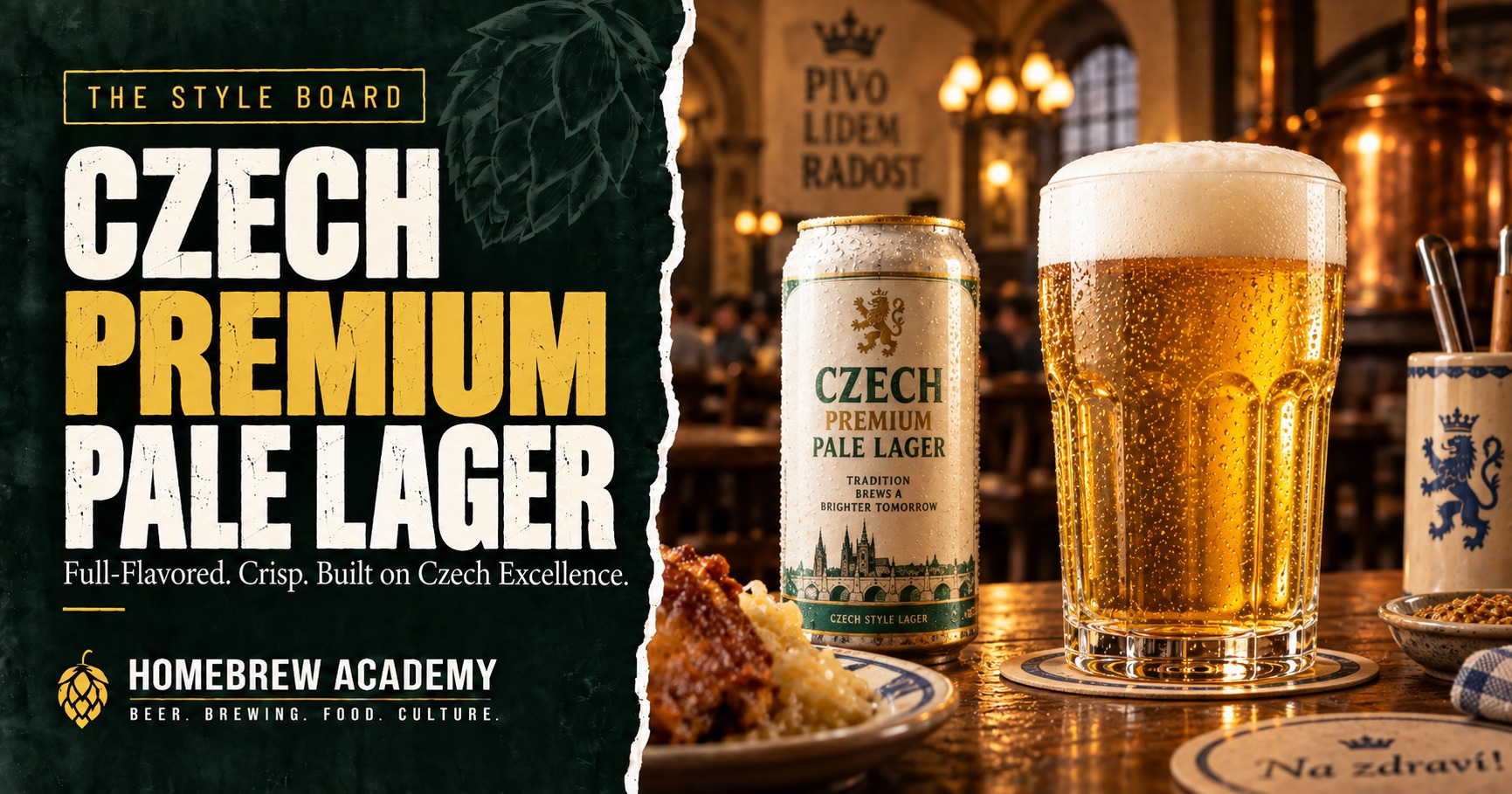
Czech Premium Pale Lager: Top 10 Current Beers and Style Guide

THE ORIGINAL PILSNER TRADITION

Czech Premium Pale Lager combines rich bread-like malt, spicy-herbal hops and strong bitterness in a rounded, remarkably drinkable balance.

This is the Pilsner-type Czech lager most drinkers recognize, but the style is broader than one famous brewery and richer than the generic word “pilsner” suggests.

The quick answer

Expect brilliant gold color, dense white foam, medium body, low-to-moderate carbonation and a long finish where rich bread and firm spicy bitterness remain in conversation.

MeasureBJCP range
Original gravity1.044–1.060
Final gravity1.013–1.017
Bitterness30–45 IBU
Color3.5–6
Alcohol4.2–5.8%

What Czech Premium Pale Lager tastes like

The malt can suggest fresh bread, crust, honey or a slight caramel impression. Czech hops bring spice, flowers and herbs, often at levels that would seem aggressive without soft water and full malt.

Bitterness is pronounced but not abrasive. A very low fruity ester or light diacetyl note is optional, and the finish may lean maltward or hopward without becoming unbalanced.

Top 10 current Czech Premium Pale Lager references

These HBA editorial selections compare current Czech premium pale lagers through rounded malt, traditional hop character and a clean finish. The order is a comparison flight, not a blind-tasting ranking. Bakalář’s cold-hopped lager is explicitly labeled a more aromatic variation. Product specifications refer to the named beer and market, and current production does not guarantee local stock.

Pilsner Urquell
#1 in this roundup
Beer profile

Pilsner Urquell

Brewed by Plzeňský Prazdroj

StyleCzech Premium Pale Lager
ABV4.4%
ReferenceTriple decoction
Brewed inPlzeň, Czech Republic

The original Pilsen reference: rounded malt and assertive Saaz bitterness.

BAR NOTES

Pilsner Urquell establishes the Pilsen reference at 4.4% ABV, with the brewery’s traditional triple-decoction process and Saaz hop identity. Its balance is richer and rounder than a very lean German pils, while substantial bitterness remains part of the whole beer.

Use it as the first premium pour rather than treating the famous name as an automatic winner. The pilsner roundup makes a useful next flight for comparing a drier finish and sharper hop definition with Czech malt roundness.

Budweiser Budvar Original
#2 in this roundup
Beer profile

Budweiser Budvar Original

Brewed by Budějovický Budvar

StyleCzech Premium Pale Lager
ABV5.0%
ReferenceCzech original · 5.0%
Brewed inČeské Budějovice, Czech Republic

A fuller South-Bohemian premium lager with pale malt and traditional hops.

BAR NOTES

Budvar Original moves the flight to České Budějovice at 5.0% ABV, giving the premium category a second major Czech reference. Keep it distinct from the American Budweiser brand and from Budvar’s dark or stronger beers, which serve different tasting purposes.

Compare bread-like malt, hop flavor and finishing dryness separately beside Urquell, keeping both beers equally fresh. The helles roundup helps isolate softer malt emphasis, while the Czech selections broaden the flight beyond these two internationally familiar names.

Radegast Ryze Hořká 12
#3 in this roundup
Beer profile

Radegast Ryze Hořká 12

Brewed by Radegast / Plzeňský Prazdroj

StyleCzech Premium Pale Lager
ABV5.1%
Reference36 IBU · 12°
Brewed inNošovice, Czech Republic

A bitter-leaning premium Czech lager with a current 36 IBU specification.

BAR NOTES

The current producer portfolio lists Ryze Hořká 12 at 5.1% ABV and 36 IBU. It makes the hop-focused side of Czech premium lager explicit without borrowing the stronger alcohol or different fermentation profile of an IPA.

Pour it beside Rázná 10 in the Czech pale guide to compare a producer’s lower- and higher-gravity beers. The pilsner selections then extend the bitterness comparison across regions without equating every bitter pale beer with one recipe.

Bernard Celebration Lager
#4 in this roundup
Beer profile

Bernard Celebration Lager

Brewed by Bernard Family Brewery

StyleCzech Premium Pale Lager
ABV5.0%
Reference37 IBU · bottle conditioned
Brewed inHumpolec, Czech Republic

A yeast-conditioned celebration lager with bread-like malt and herbal bitterness.

BAR NOTES

Bernard Celebration Lager is the producer’s Sváteční ležák, listed at 5.0% ABV and 37 IBU with additional yeast for secondary bottle fermentation. It is a distinct product from Bernard’s standard Dvanáctka, so the two names and alcohol figures should not be interchanged.

Pour gently if you prefer less yeast in the glass, then compare its texture with filtered premium references. The Kellerbier roundup offers another route into less-filtered lager character, while Czech premium pale remains the guide for this beer’s underlying malt-and-hop balance.

Primátor Premium
#5 in this roundup
Beer profile

Primátor Premium

Brewed by Pivovar Primátor

StyleCzech Premium Pale Lager
ABV5.0%
ReferencePremium světlý ležák
Brewed inNáchod, Czech Republic

A traditional Czech premium lager for comparing malt depth and hop balance.

BAR NOTES

Primátor Premium supplies Náchod’s 5.0% pale lager as a regional comparison beside the largest exported brands. Use this Premium product rather than the brewery’s lower-strength Antonín, amber thirteen-degree beer or dark lager when evaluating the premium pale category.

Keep color, body and bitterness as separate observations, because a golden beer can still offer several different balances. The International Pale Lager guide provides a restrained commercial comparison that helps explain what Czech premium lager adds in malt depth and traditional hop character.

Svijanský Máz 11
#6 in this roundup
Beer profile

Svijanský Máz 11

Brewed by Pivovar Svijany

StyleCzech Premium Pale Lager
ABV4.8%
Reference11° · unpasteurized
Brewed inSvijany, Czech Republic

An unpasteurized eleven-degree pale lager within premium pale strength.

BAR NOTES

Svijanský Máz is an eleven-degree pale lager listed at 4.8% ABV in the current brewery portfolio. Its strength fits the premium pale range despite the eleven-degree name, illustrating why original extract and alcohol are related measurements rather than interchangeable numbers.

Try it beside the brewery’s Desítka in the lower-strength Czech guide before moving to the twelve-degree beers. The Czech lager roundup gives more examples of those labeling classes without assuming a numerical suffix guarantees one flavor profile.

Velkopopovický Kozel 11
#7 in this roundup
Beer profile

Velkopopovický Kozel 11

Brewed by Velkopopovický Kozel / Plzeňský Prazdroj

StyleCzech Premium Pale Lager
ABV4.6%
Reference11° · three malts
Brewed inVelké Popovice, Czech Republic

Three malts give this eleven-degree pale lager a rounded everyday balance.

BAR NOTES

Kozel 11 is listed by its producer at 4.6% ABV with a three-malt recipe. Choose the eleven-degree pale product for this comparison, keeping it separate from Kozel Dark and market-specific Premium bottles whose names and strengths are different.

Its lower premium-range strength makes a useful midpoint between the session board and the fuller five-percent beers. Explore the Mexican lager selections for another approachable flight where pale refreshers and maltier amber beers share a country but serve different comparison purposes.

Bakalář Rakovnický Ležák za studena chmelený
#8 in this roundup
Beer profile

Bakalář Rakovnický Ležák za studena chmelený

Brewed by Pivovar Rakovník

StyleCzech Premium Pale Lager
ABV5.2%
ReferenceCold-hopped variation
Brewed inRakovník, Czech Republic

A cold-hopped Czech pale lager for the more aromatic edge of the board.

BAR NOTES

Bakalář’s za studena chmelený is a 5.2% Rakovník pale lager with a cold-hopping emphasis. It belongs here as an explicitly hop-forward variation, letting added aroma become part of the comparison rather than pretending every commercial reference exactly matches a competition template.

Taste it after the quieter premium lagers so extra hop aroma does not erase their differences. The Italian pilsner roundup provides a neighboring cold-hopped tradition, making the technique a useful comparison without renaming this Czech product as an Italian beer.

Zubr Grand 11
#9 in this roundup
Beer profile

Zubr Grand 11

Brewed by Pivovar Zubr

StyleCzech Premium Pale Lager
ABV4.8%
Reference11° · 4.8%
Brewed inPřerov, Czech Republic

An eleven-degree Moravian lager with a full malt-and-hop balance.

BAR NOTES

Zubr Grand 11 contributes a Přerov premium-lager reference at the current producer’s 4.8% ABV. Its eleven-degree designation fits comfortably alongside the other mid-strength beers here, while remaining distinct from Zubr’s lower-strength Gold and stronger Max products.

Compare Grand with Svijanský Máz to hear regional differences within the same nominal gravity class. The pilsner selections supply a contrasting hop-and-finish flight, helping keep brewery location, original extract and sensory balance as three separate observations.

Staropramen Premium
#10 in this roundup
Beer profile

Staropramen Premium

Brewed by Staropramen

StyleCzech Premium Pale Lager
ABV5.0%
ReferenceProducer 5.0%
Brewed inPrague, Czech Republic

A Prague premium lager with rounded malt and a refreshing finish.

BAR NOTES

Staropramen Premium completes the board with the producer’s 5.0% pale lager from the Prague brand. This is the Premium reference, distinct from Staropramen Dark and Granát; the producer’s graphic bitterness scale is not a published IBU measurement.

Finish by comparing it directly with your first Urquell pour at the same temperature, rather than judging brand familiarity. The helles selections and pilsner roundup offer two different next steps: softer malt emphasis or a broader exploration of traditional pale-lager hops.

How the style is brewed

Czech malt, traditional hops, Czech lager yeast and low-sulfate water define the base. Decoction mashing is historically important for building rich malt flavor and texture.

Cool fermentation and extended lagering preserve smoothness. Lower carbonation than many German pilsners helps the beer feel rounded, while proper foam service lifts aroma and manages bitterness.

History and Czech context

Pilsner Urquell was first brewed in Plzeň in 1842 after local burghers built a new brewery and hired Bavarian brewer Josef Groll. Pale malt technology and lager fermentation changed world beer.

In the Czech Republic, the Pilsner name is used narrowly, while beers elsewhere may be called Czech or Bohemian Pilsner. BJCP combines pale ležák and stronger pale speciální versions here.

Serving and food pairing

Serve at 40–45°F in a Czech mug or tall lager glass with a dense head. Lower carbonation and proper foam help the beer feel creamy rather than fizzy.

Excellent pairings include schnitzel, sausages, roast pork, fried cheese, grilled chicken and washed-rind cheese. The bread-and-hop combination handles salt, fat and browning.

How it differs from nearby styles

It has more color, body and malt richness than German Pils, with a fuller finish and softer bitterness. Czech Pale Lager is lower in strength and intensity.

International Pale Lager is typically drier, more neutral and less hop-rich. Czech Premium Pale Lager should feel layered and long rather than merely crisp.

Czech Premium Pale Lager FAQ

Is Czech Premium Pale Lager the same as Pilsner?

It is the Czech Pilsner-type style, although the Pilsner name is used more narrowly inside the Czech Republic.

Why does it taste fuller than German Pils?

Higher finishing gravity, Czech malt, decoction traditions, yeast choice and lower carbonation contribute a rounder body.

Is Pilsner Urquell the only example?

No. It is the historical benchmark, but many Czech breweries produce pale ležák and speciální lagers with different malt-hop balances.

Can the beer be cloudy?

Most examples are brilliant, but kvasnicové versions may be lightly cloudy from kräusening or an added dose of yeast.

Should bitterness be strong?

Yes. The BJCP range is 30–45 IBU, but soft water and full malt should keep that bitterness clean and rounded.

Style ranges and definitions follow the BJCP 2021 Beer Style Guidelines.

KEEP THE FLIGHT GOING

Take your premium pilsner flight further.

Follow rich pale malt, traditional hops and clean fermentation into Czech, Italian and Bavarian comparisons.